Encoder selection is often reduced to resolution, interface and purchase price. In a real motion-control system, the choice reaches further. It affects what the drive knows after power-up, how the machine establishes its reference, what movement is acceptable during startup, and how much supporting hardware and software are needed.
Supporting both incremental and absolute feedback gives the designer room to choose the architecture around the machine instead of designing the machine around one feedback type.
Startup behavior: what must be known before the machine moves?
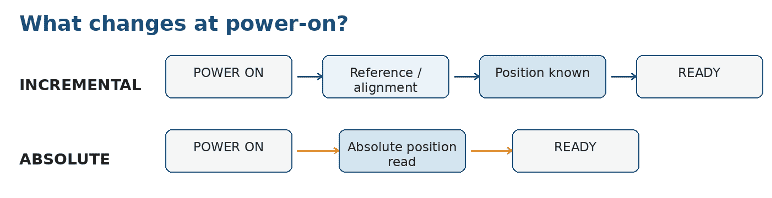
Power-on is where the two approaches feel most different.
An incremental encoder reports movement as pulses, so the drive can calculate position, speed and direction very precisely while the machine is running, but only relative to the starting position. After power has been removed, however, the encoder can’t “tell” the system its absolute mechanical position. A reference may therefore have to be established before normal positioning can begin.
An absolute encoder always returns a position value, allowing the drive to continuosly read shaft position immediately after power-up.
This difference also appears in motor control start-up. Field-Oriented Control requires a known rotor electrical position before torque can be controlled correctly. What matters at system level is therefore simple: what position information is available at start-up, and what must the machine do before it is ready to move?
Technosoft drives support different ways of establishing that starting position according to the feedback available. An incremental system may use an alignment routine, Hall information or a motionless-start method; with an absolute position sensor, the drive can use the read position directly once the sensor-to-motor offset has been set during commissioning. The important design point is whether the machine can tolerate the movement, time and sequence needed to establish its starting reference.
A vertical axis makes the issue easy to see. After a power interruption, the control system may need to know the load position before any motion is allowed. On a free-running axis, a short reference movement may be harmless. Near a hard stop or in a synchronized multi-axis machine, the same movement can complicate the recovery.
System accuracy: position knowledge and measurement resolution are different
Absolute feedback should not be treated as a synonym for higher accuracy. A high-resolution incremental encoder can provide excellent position and speed feedback during operation. Resolution describes how finely movement can be measured; absolute position describes whether the system knows where the axis is after startup or a power loss.
The final positioning accuracy of the machine still depends on the encoder specification and on the mechanics around it: transmission backlash, compliance, mounting, calibration and control-loop performance all matter. Absolute feedback removes the need to recreate the encoder position reference at startup, but it does not remove mechanical error. This distinction is important when the design objective is precision rather than simply position retention.
Overall cost: the encoder price is only one line in the budget
Incremental encoders are often attractive because the sensor itself is simple and economical. The complete solution, however, may also need a home or reference switch, additional wiring and I/O, a mechanical reference location, homing software, extra commissioning work and time in the startup sequence. Recovery after a power interruption can add another cost if the machine has to re-reference before production resumes.
Absolute encoders generally cost more and require the correct communication interface, configuration and offset setup. In return, they can remove or simplify parts of the reference and recovery architecture. On one machine the incremental solution may still be clearly less expensive; on another, the extra sensor cost can be small compared with the hardware, engineering time or downtime avoided. The useful comparison is therefore total system cost, not encoder price alone.
Choosing the feedback architecture
A useful selection discussion starts with the machine, not the encoder catalogue. Can the axis home safely? Must position be known before any movement? How much recovery time is acceptable after a power interruption? Is a reference switch easy to install and maintain? What level of measurement accuracy is actually required? The answers usually make the trade-off much clearer.
| Design question | Incremental feedback | Absolute feedback |
| Can the machine establish a reference safely? | Well suited when homing or another reference step is acceptable. | Useful when a reference move is undesirable or unavailable. |
| Must position be known immediately after power-up? | Requires a system strategy to establish the mechanical reference. | Position can be read directly at startup. |
| Is startup movement restricted? | Possible, but the start method and mechanics must be considered. | Can simplify startup when direct position is available. |
| What drives the cost decision? | Lower sensor cost; reference hardware, logic and recovery may add cost. |
Higher sensor/interface cost; reference and recovery architecture may be simpler. |
Why supporting both matters
Technosoft intelligent drives support several feedback technologies, including incremental encoders, Sin/Cos encoders, Hall sensors and absolute encoders. Depending on the drive family, supported absolute interfaces include SSI, BiSS-C, EnDAT, Tamagawa, Panasonic, Nikon and Sanyo Denki. This flexibility allows the same motion-control platform to be used across machines with different startup, accuracy and cost constraints.
That can be valuable when a machine family has more than one feedback requirement. A cost-sensitive axis that can home safely may use incremental feedback, while another axis in the same system may need absolute position immediately after a restart. Supporting both avoids turning the encoder choice into a limitation.
Conclusion
The choice between incremental and absolute encoders is not only a sensor decision. It changes what the system knows at power-on, how startup and recovery are handled, and where cost appears in the machine. Incremental feedback remains a strong solution when relative motion information is sufficient and a reference can be established safely. Absolute feedback becomes especially useful when position must be known before movement, restart time matters, or the mechanical system makes homing difficult. The right choice is the one that fits the complete machine: its accuracy target, startup behavior and total system cost.
Contact our team today!