Dual-loop control is a servo drive strategy that uses both motor and load encoders to eliminate backlash, compensate for compliance, and ensure precise load positioning
Introduction: Precision Challenges in Motion Control
In motor control systems, unaddressed mechanical imperfections like backlash and load elasticity can lead to significant positioning errors, reduced precision, and even premature system wear. This is especially critical in high-precision environments such as robotics, semiconductor equipment, and CNC machines.
Technosoft drives offer an advanced dual-loop control system that enhances motion accuracy by simultaneously using two feedback signals—one from the motor and one from the load. This capability, fully supported in EasyMotion Studio II, allows engineers to minimize the mechanical imperfections effect without needing expensive hardware redesigns.
This article explains the concept of dual-loop control, its structure in Technosoft drives, and why it’s essential for maintaining performance and safety in demanding applications.
What Is Dual-Loop Control?
Single-Loop Limitation
Most traditional motion systems use a single feedback loop — typically an encoder mounted on the motor shaft. This setup works well when the connection between motor and load is rigid. But in systems using gearboxes, belts, or flexible couplings, this is no longer the case. Mechanical discrepancies between the motor and the load go undetected by the motor encoder, leading to positioning errors.
Dual Feedback Strategy
Technosoft drives offer dual-loop control by introducing the possibility to read a second encoder mounted at the load. This setup enables the system to:
- Use the motor encoder for fast current and velocity control
- Use the load encoder for precise position control.
With both encoders active, the drive can compensate in real-time for errors introduced by the mechanics between the motor and the load.

Key Advantages
Reduces the effect of backlash
Backlash in gear systems can lead to dead zones and positioning delays. Dual-loop strategy controls both motor and load movement, allowing the drive to inherently correct the backlash at runtime —especially useful in applications like CNC machines or robotic joints.
Flexibility Management
Transmission elements like belts or flexible couplings introduce delays and mechanical lag. With dual-loop control, the position loop based on the load encoder accounts for these issues, adjusting motor behavior in an effort to preserve positioning accuracy.
Precision and Repeatability
Dual-loop control enables the system to rely on the actual load position rather than estimated position, reducing steady-state error and improving repeatability. It’s particularly advantageous for systems requiring high resolution or consistent cycle-to-cycle performance.
Implementing Dual-Loop Control with Technosoft Drives
Proper configuration of encoder types, resolutions, and gear ratios is essential. Technosoft’s EasyMotion Studio II facilitates this setup through intuitive wizards and graphical interfaces.
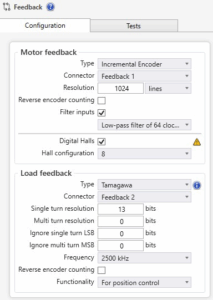
A successful dual-loop implementation relies on the correct selection of encoders:
- Motor encoder: Typically ≥ 500 counts per turn (cpt); 1024 cpt is common.
- Load encoder: Should be selected based on application precision — generally 2–4× the desired resolution. For example, for 0.1° precision, use ≥ 2048 cpt.
When and Where to Use It
Dual-loop control becomes essential in applications with mechanical elasticity or backlash that cannot be eliminated mechanically. Typical domains include:
- Robotics – High-precision end-effector control
- CNC Machinery – Eliminating screw backlash effects
- Semiconductor Assembly – Sub-micron positioning
- Printing/Packaging – Precise registration and alignment
- Medical Equipment – Accuracy in surgical or diagnostic tools
Conclusion
Technosoft’s dual-loop control system is a key feature for precision motion control. It enhances positioning accuracy, compensates for mechanical imperfections, and stabilizes systems prone to dynamic disturbances. Thanks to EasyMotion Studio II, engineers can quickly setup and fine-tune dual-loop architectures with visual tools and clear configuration options.
Contact our team today!